Rebuilding the Connection Between Effort and Stability
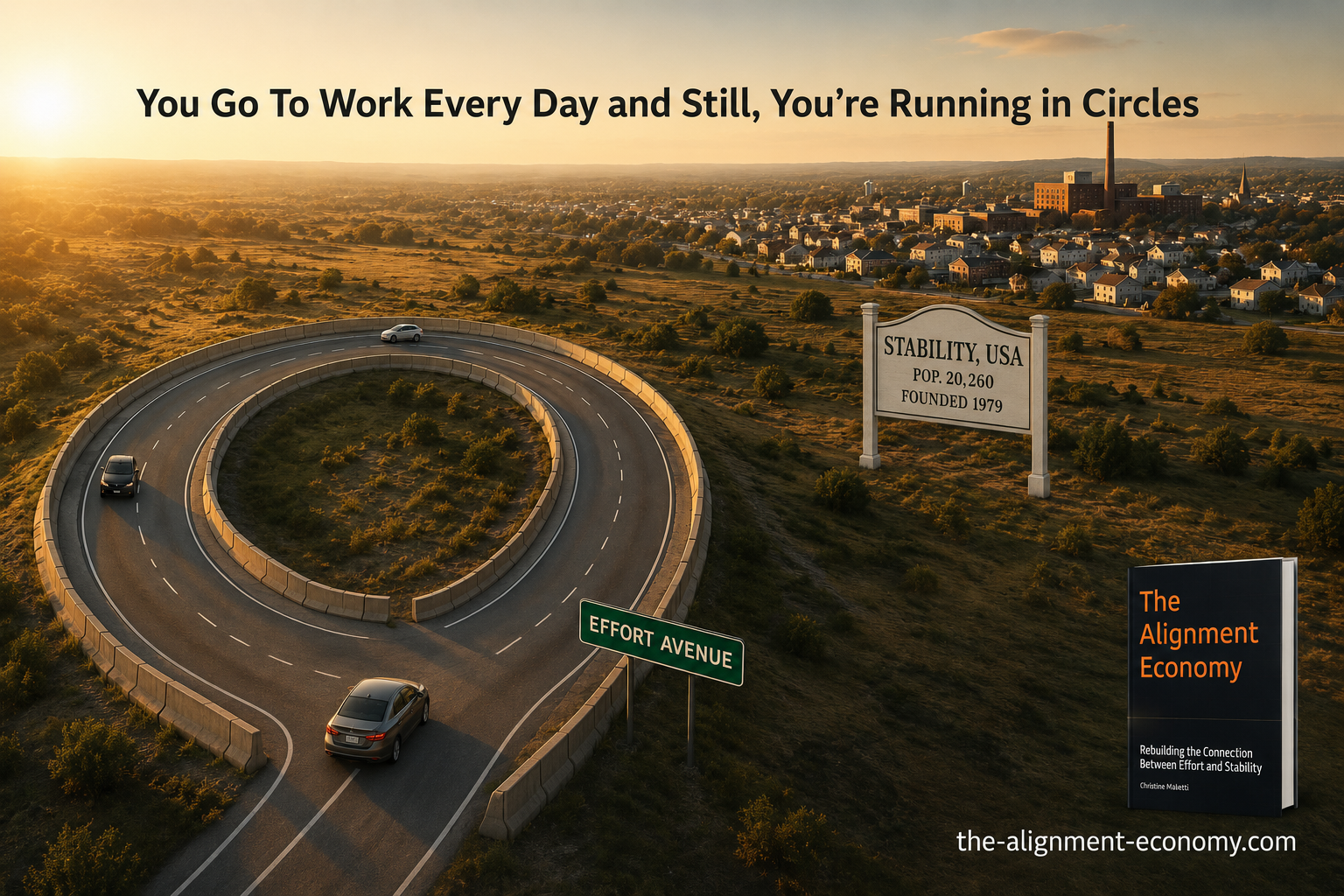
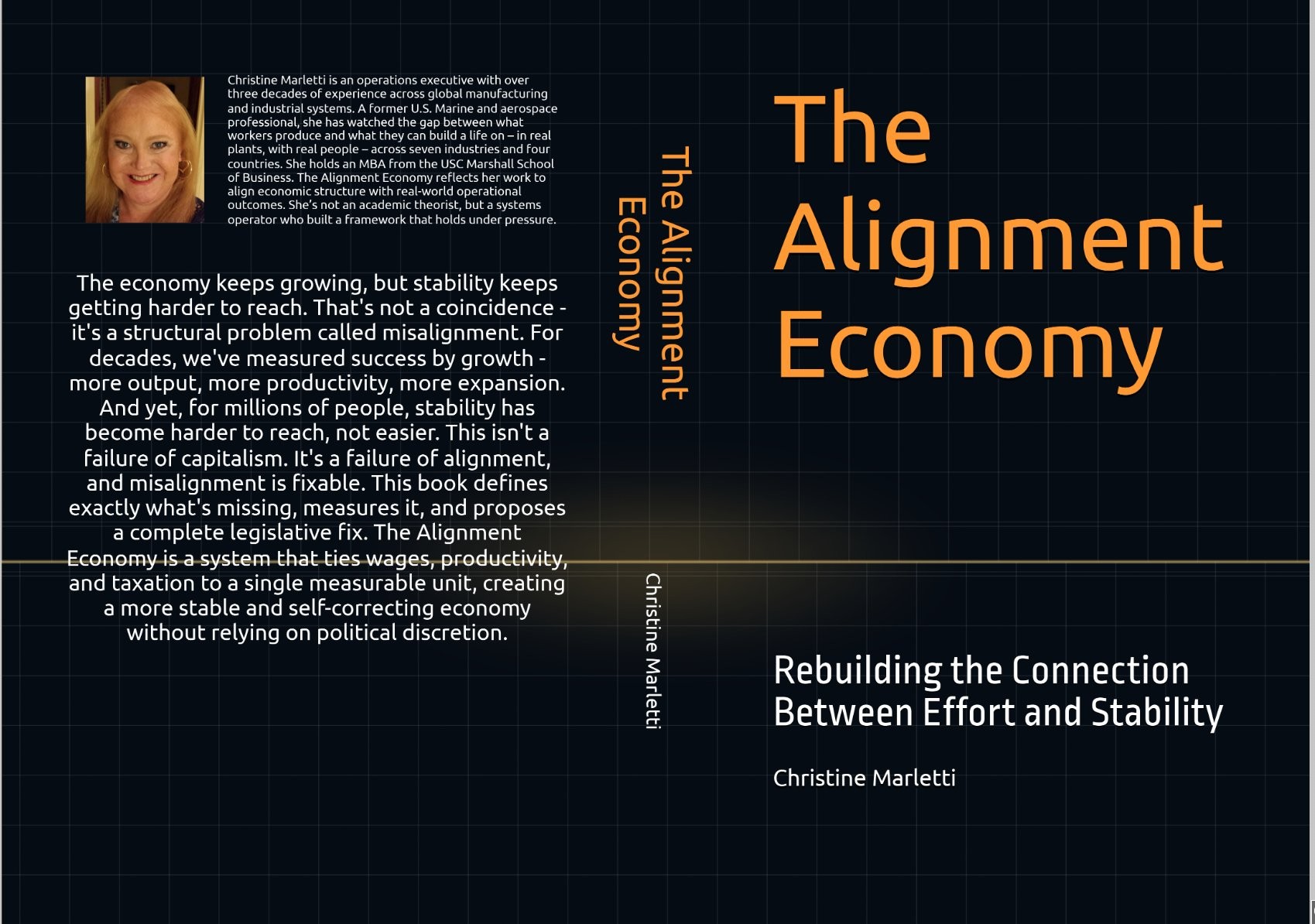
The economy keeps growing, but stability keeps getting harder to reach. That's not a coincidence — it's a structural problem called misalignment. This book defines exactly what's missing, measures it, and proposes a complete, implementable fix.
Christine Marletti is an operations executive with over three decades of experience across global manufacturing and industrial systems. A former U.S. Marine and aerospace professional, she has watched the gap between what workers produce and what they can build a life on — in real plants, with real people — across seven industries and four countries.
She holds an MBA from the USC Marshall School of Business. The Alignment Economy reflects her work to align economic structure with real-world operational outcomes. She's not an academic theorist, but a systems operator who built a framework that holds under pressure.
"This isn't a failure of capitalism. It's a failure of alignment — and misalignment is fixable. This book defines exactly what's missing, measures it, and proposes a complete legislative fix: a system that ties wages, productivity, and taxation to a single measurable unit, creating a more stable and self-correcting economy without relying on political discretion."
I grew up poor. Not the kind of poor that gets romanticized in retrospect — the kind where your school clothes come from Goodwill and you eat meals like goulash or chili surprise, because your parents are quietly stretching whatever is left. You don't recognize it as poverty when you're living it. You recognize it later, when you understand what your parents were doing and why.
My father was a Teamster who drove a truck for forty-two years. My sisters built lives with their hands and their persistence. None of them lacked effort. None of them lacked diligence. What the system lacked was any mechanism to translate that effort into stability — and over time, despite everything they did right, the distance between what they earned and what things cost kept growing.
"The difference between us was not effort. It was circumstance — the kind of circumstance that our current system was never designed to account for."
I have been incredibly fortunate. I went to school while working full time, pushed as hard as I could for as long as it took, and found a position in this economy where I am not behind. I am aware of what that cost and I am aware that others who worked just as hard did not end up where I did.
There is a saying I have carried for years: if you finally make it to the top, the least you can do is send the elevator back down. That is what this book is. It is not a policy paper written from a distance. It is an attempt by someone who felt the weight of that shame — the public assistance, the thrift store clothes, the careful silences around money — to build something that might prevent the next family from feeling it too.
Regardless of title or position, we are all one unfortunate set of circumstances away from being left behind. I think about this often. This work exists because I have not forgotten that.

The book makes the argument. These documents provide the complete technical and legislative architecture behind it. Download free — just leave your email so we can send you updates as the work evolves.
The misalignment isn't a feeling. It's in the federal data. These four charts — drawn from BLS, BEA, Census Bureau, and peer-reviewed research — show the same gap from four different angles. Each one tells part of the story. Together they make it undeniable.
Indexed growth since 1948 (1948 = 100) — net productivity vs. typical worker compensation, inflation-adjusted. Before 1979 the two lines move together. After 1979 they diverge and have never reconnected.
Cumulative real income growth since 1979 by income group, in 2023 dollars. The economy grew for everyone. But it grew four times faster at the top than in the middle.
Nominal vs. real median household income growth since 1967. Two ways to measure the same paycheck. One counts dollars. The other asks what those dollars buy.
Real GDP per capita vs. real median household income since 1984. In a well-aligned system these two lines move closer together over time. The gap between them is where the drift accumulates.
From diagnosis to mechanism to full implementation — a structural case for rebuilding alignment between effort, productivity, and stability.
That's not a complaint. It's a structural diagnosis — and there's a framework for fixing it. Subscribe for the argument, the mechanics, and the human stories behind both. Free. Twice a week.
No spam · Unsubscribe anytime · Your email stays with us